All guidesUpdated · 6 min read
OpenClaw vs Claude Code (and Claude Cowork): what’s the difference?
OpenClaw is a self-hosted personal assistant you text from WhatsApp or Telegram, and it works with any model. Claude Code is Anthropic’s coding agent, running on your Claude plan in the terminal, your editor, a desktop app or the web. Claude Cowork is Claude Code’s sibling for everyday office work. In 2026 the lines blurred: Claude Code now takes messages from Telegram and runs on a schedule. The short answer: code with Claude Code, do office work with Cowork, and choose OpenClaw when you want any model, inside your chat apps, on a machine you control.
"Should I use OpenClaw or Claude Code?" is a slightly odd question, because they started out as different things. It's a fair question now, though. Both can run unattended, both can be reached from your phone, and both can do far more than their original job. And after Anthropic changed how Claude subscriptions work with third-party agents, the choice also changes what you pay.
Here's how they compare in November 2026, with Claude Cowork added, since it's the option most comparisons leave out.
The short version
| OpenClaw | Claude Code | Claude Cowork | |
|---|---|---|---|
| What it is | Open-source personal assistant you run yourself | Anthropic's agentic coding tool | Anthropic's agent for knowledge work |
| Made by | OpenClaw Foundation (nonprofit), MIT license | Anthropic, proprietary | Anthropic, proprietary |
| Where you use it | WhatsApp, Telegram, iMessage, Slack and ~30 chat apps, plus a web dashboard | Terminal, VS Code, JetBrains, desktop app, web, Slack, your phone | Claude desktop app (Mac, Windows), web and mobile in beta |
| Models | Any: Claude, GPT, Gemini, DeepSeek, local models | Claude only | Claude only |
| Best at | Personal errands and automations across your chat apps | Reading and changing code, shipping pull requests | Files, documents, browser tasks, research |
| Runs on a schedule | Yes (automations, webhooks, Gmail triggers) | Yes (cloud or desktop scheduled tasks) | Yes (scheduled tasks) |
| Where it runs | Your computer or a server you manage | Your computer, or Anthropic's cloud | Your computer and Anthropic's cloud |
| What it costs | Free software + model usage + a machine | A Claude plan (Pro from $20/mo) or API usage | Included in paid Claude plans |
What each one is really for
OpenClaw is the one you text. It sits on your computer or a server, connects to your chat apps, and takes requests like "move my 3pm to Thursday and tell Sam" or "every morning, summarize my unread newsletters". Its strength is breadth: about 30 chat channels, a large catalog of community skills on ClawHub, and any model you like, including local ones. It started life as "Clawdbot" in late 2025, was briefly "Moltbot", and has been OpenClaw since January 2026.
Claude Code is the one that works in your codebase. It reads your repo, edits files, runs commands and tests, and opens pull requests, from the terminal, your editor, a desktop app or the browser. It's also become a general agent: plenty of people point it at a folder of documents or a server and never write a line of code.
Claude Cowork brings the same agent to non-coding work. You give it a goal ("turn these receipts into an expense report"), and it works across your files, connected apps and a browser, then hands you the result to review. It's included in every paid Claude plan.
Where they overlap now
The old comparison said: Claude Code lives in a terminal, OpenClaw lives in your phone. That's out of date.
- Chat apps: Claude Code's Channels push messages from Telegram, Discord and iMessage into a session.
- From your phone: Remote Control lets you continue a desktop session from your phone, and Dispatch lets you start one from it.
- On a schedule: Claude Code runs scheduled tasks in Anthropic's cloud (your computer can be off) or on your desktop; Cowork has scheduled tasks too.
- Memory: Claude Code keeps project instructions in CLAUDE.md and learns with auto memory; OpenClaw keeps Markdown memory files. Neither forgets everything between sessions any more.
What still sets OpenClaw apart: any model, many more chat apps, a big skill catalog, and everything running on a machine you control.
Cost, and the Claude plan question
This is where the choice gets real.
Claude Code and Cowork run on your Claude plan. Pro is $20 a month, Max $100 and Ultra $200 (Anthropic renamed "Max 20x" to Ultra at the end of October 2026). Heavy users stay inside a flat monthly price.
OpenClaw is free, but the model isn't. You pay for an API, plus a machine if you don't use your own. People who run OpenClaw around the clock on a top model report bills from tens to hundreds of dollars a month; heartbeats that check in every 30 minutes add up.
Using a Claude plan with OpenClaw got complicated. On April 4, 2026, Anthropic stopped letting Pro and Max limits cover OpenClaw's own Claude sign-in, saying its subscriptions "weren't built for the usage patterns of these third-party tools". Users got a one-time credit and moved to extra usage or an API key. Anthropic later announced, then paused, a separate monthly credit for third-party agents. Today OpenClaw's docs recommend an API key, or a "Claude CLI" route that hands work to the official claude command on your machine, which uses your plan. Check Anthropic's help center before you rely on any of this; it has changed several times.
Rule of thumb: if you already pay for Claude, Anthropic's own tools are the cheapest way to use it.
Security and control
OpenClaw runs with the permissions you give it on your machine, unless you set up sandboxing. Its popularity made it a target in early 2026: hundreds of malicious skills turned up on ClawHub, and security firms counted tens of thousands of OpenClaw dashboards exposed to the internet. Keep it updated, bind it to localhost, and only install skills you've read.
Claude Code asks before it edits files or runs commands, with permission modes you can loosen or tighten, and hooks to enforce your own rules. Cowork asks app by app before it uses your computer. Neither is magic: an agent that reads email or web pages can still be steered by what it reads (prompt injection). But you don't run a server, and Anthropic patches the product.
Which should you use?
Use Claude Code if your work is mostly code, you already pay for Claude, or you want the strongest agent in a repo with the least setup.
Use Claude Cowork if your work is mostly documents, spreadsheets, research and the browser, and you'd rather not run anything yourself.
Use OpenClaw if you want any model (including local ones), you want to live in WhatsApp, iMessage or Telegram, and you're happy to be the admin of your own always-on assistant.
Use more than one if it makes sense: a lot of people run Claude Code for their repo and OpenClaw for personal errands.
When one agent isn't enough
All three are built around one person and their sessions. Claude Code can run several sessions side by side, but keeping track of which session does what, what each one is allowed to touch, and what's waiting on you gets messy once you have more than a few, and more so when colleagues are involved.
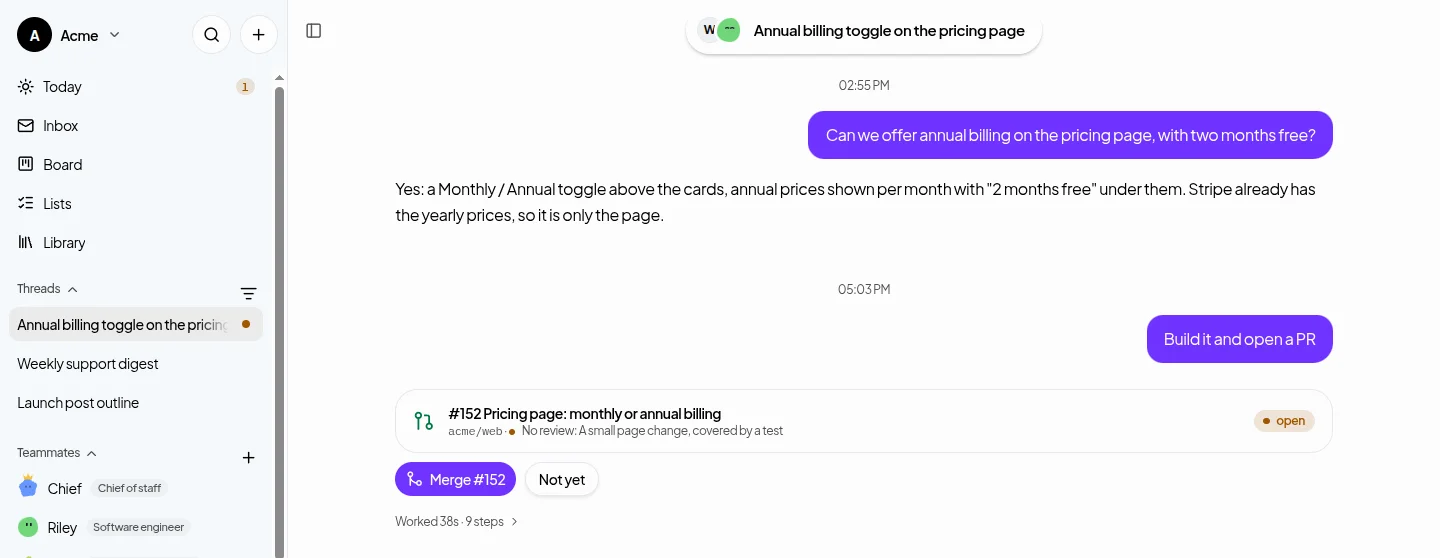
That's the gap Brigade fills. Brigade is an open-source app that runs the official Claude Code and Codex as a team of AI teammates, each signed in with your own account, so your Claude or ChatGPT plan does the work and Brigade never bills you for AI usage. Each teammate has a job (support, marketing, sales, code), its own computer, the Apps you give it and a shared memory. They start on their own from schedules and events, your colleagues work in the same threads, and the actions you choose (an email, a Stripe change, a merge) wait for your yes in one list on your phone.
It's free on your own computer; Brigade Cloud ($99 a month per workspace) gives teammates a computer that stays on. Compare it directly: Brigade vs Claude Code and Codex alone, Brigade vs OpenClaw, Brigade vs Claude Cowork.
Questions people ask
What is the difference between OpenClaw and Claude?
Claude is Anthropic’s family of AI models and apps, including Claude Code and Claude Cowork. OpenClaw is an independent open-source assistant that you run yourself and that can use Claude or any other model, through chat apps like WhatsApp and Telegram.
Is OpenClaw good for coding?
It can run coding tasks, but it isn’t built for them. Claude Code, Codex or a coding-focused agent will understand a repository, run tests and open pull requests far better. Many people use Claude Code for code and OpenClaw for personal automations.
Is Claude Code better than OpenClaw?
For software work, yes. For a personal assistant inside your chat apps that can use any model, OpenClaw fits better. Since 2026 Claude Code also takes messages from Telegram, Discord and iMessage and runs scheduled tasks, so the overlap is growing.
Can I use my Claude subscription with OpenClaw?
Not directly through OpenClaw’s own Claude sign-in since April 2026; that draws on paid extra usage. OpenClaw’s docs recommend an API key or a route that runs the official Claude CLI on your machine, which uses your plan. Anthropic changed these rules several times in 2026, so check its help center.
What is Claude Cowork and how is it different from OpenClaw?
Claude Cowork is Anthropic’s agent for non-coding work, included in paid Claude plans. It works across your files, apps and a browser and runs scheduled tasks, with nothing to host. OpenClaw is self-hosted, works with any model and lives in your chat apps, but you run and secure it yourself.
Sources, checked on November 15, 2026
What this guide says about other products comes from these pages. Products change: if something here is out of date, open an issue on GitHub.
- OpenClaw on GitHub
- OpenClaw docs: Anthropic provider
- Claude Code overview
- Claude Cowork
- Claude pricing
- The Next Web: Claude Max renamed Ultra
- TechRadar: you’ll need to pay to use OpenClaw now
- Claude help center: the Agent SDK with your Claude plan
- TechCrunch: OpenClaw’s rename
- The Hacker News: 341 malicious ClawHub skills